·Ghana Free Zones
African Continental Free Trade Area: Why Ghana Matters to Investors
The African Continental Free Trade Area is changing how businesses think about Africa. Discover what AfCFTA means for investors and why Ghana could play a strategic role in accessing opportunities across the continent.
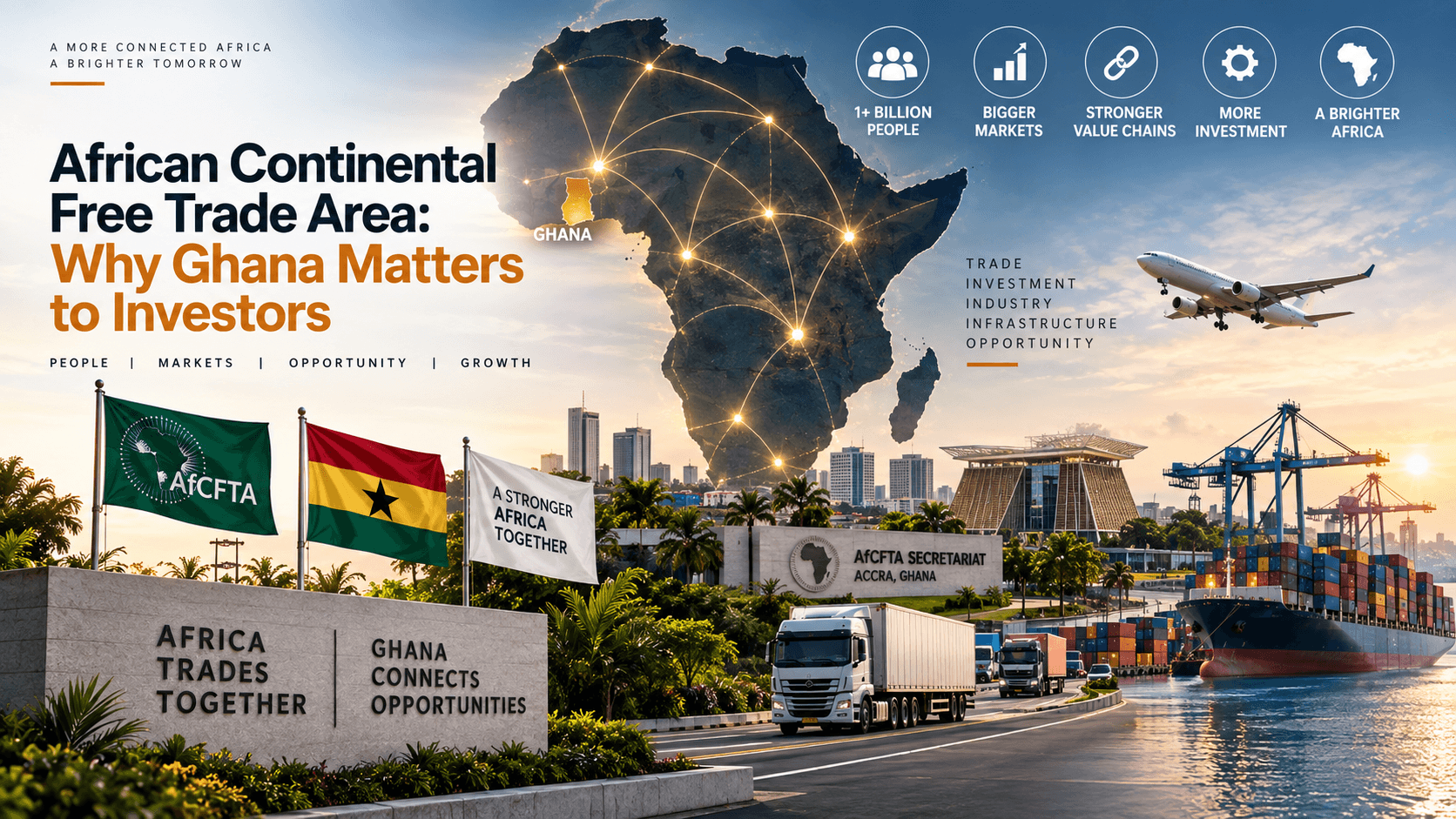
Africa has long been described as a continent of opportunity. But for businesses, one challenge has remained: operating across dozens of markets with different trade rules, tariffs, and border requirements.
The African Continental Free Trade Area (AfCFTA) is designed to change that.
Rather than viewing African countries only as separate markets, AfCFTA is working toward a more integrated continental market where goods and services can move more easily across borders.
For investors, manufacturers, and businesses looking at Africa, that could significantly change how they think about where to establish operations and which markets they can serve.
What Is the African Continental Free Trade Area?
AfCFTA is a continent-wide trade agreement that aims to reduce barriers to trade between African countries.
Its first phase began implementation in January 2021 and provides for the gradual elimination of tariffs on most goods alongside measures to reduce barriers to trade in services. The wider AfCFTA agenda also covers areas including investment, competition, intellectual property and digital trade.
The ambition is significant. The agreement brings together a market of well over a billion people. It is intended to make it easier for African businesses to trade with one another, participate in regional value chains and attract investment.
But the real story isn't simply the size of the market.
It is what businesses may be able to do with access to it.
Why Should Investors Care?
Imagine establishing a manufacturing operation in one African country but having customers across several others.
Without deeper regional integration, moving goods between those markets can mean tariffs, lengthy border procedures, and different regulatory requirements. These costs can make regional expansion difficult even when demand exists.
AfCFTA aims to reduce some of those barriers.
The World Bank estimates that deeper implementation of AfCFTA—including investment and competition reforms—could increase Africa's income by as much as 9% by 2035, create almost 18 million additional jobs, and substantially increase intra-African exports. Manufacturing is expected to be among the sectors that benefit significantly.
For an investor, therefore, the question becomes bigger than:
“Which African country should I sell to?”
It becomes:
“Where should I establish my operations so I can serve multiple African markets effectively?”
That is where Ghana becomes particularly interesting.
Why Ghana Matters
Ghana offers investors something unusual in the AfCFTA story: it is not simply a participating market; Accra hosts the AfCFTA Secretariat.
But geography and policy positioning alone are not enough.
For Ghana to turn continental trade integration into real economic activity, businesses still need the physical systems that make trade possible: industrial facilities, reliable infrastructure, logistics networks, energy, storage, transport connections and access to ports.
This distinction matters.
A trade agreement can open a market on paper. Infrastructure determines whether businesses can actually reach it.
Recent World Bank analysis makes the same broader point: a large share of Africa's remaining trade costs comes from issues such as customs delays, inefficient logistics, fragmented standards and weak infrastructure—not simply tariffs.
The Opportunity Beyond Trade
AfCFTA could also influence what Africa produces, not only what it trades.
A larger connected market gives manufacturers greater reason to produce at scale. Agricultural products can be processed closer to their source. Businesses can build regional supply chains rather than relying exclusively on overseas suppliers and markets.
The World Bank projects particularly strong opportunities in areas including processed foods, textiles and apparel, and chemical, rubber and plastic products as trade and investment barriers fall.
For Ghana, that creates an opportunity to attract businesses that want to manufacture, process, distribute and serve markets beyond the country's borders.
And this is where urban and industrial development becomes part of the AfCFTA conversation.
Trade Needs Somewhere to Happen
A manufacturer cannot operate from a trade agreement.
It needs land.
It needs power.
It needs roads.
It needs a suitable facility.
It needs access to workers, suppliers, logistics networks and markets.
That is why The New Accra City Ltd sees infrastructure and planned development as part of the wider trade opportunity.
By creating coordinated environments for industrial, commercial, logistics and other economic activities, the goal is to provide the physical foundation businesses need to establish and expand their operations in Ghana.
The opportunity created by AfCFTA is therefore not simply about moving goods across borders.
It is about creating the places where those goods are produced, processed, stored, financed, and distributed in the first place.
Ghana's Opportunity Starts With Preparation
AfCFTA could reshape how companies approach Africa, but an agreement alone will not create competitive businesses or efficient trade corridors.
Countries that pair market access with infrastructure, industrial capacity, and an environment where businesses can operate efficiently will be better positioned to capture the investment opportunities that continental integration creates.
For investors considering Ghana, that makes today's location and infrastructure decisions potentially much bigger than one domestic market.
Your next facility in Ghana could be the starting point for a much larger African strategy.
Exploring manufacturing, logistics, commercial, or industrial opportunities in Ghana? Speak with The New Accra City Ltd about creating the operational base your African growth strategy needs.