·Ghana Free Zones
Ghana Free Zone Benefits: Full Tax and Trade Incentive Breakdown
Thinking of setting up an export-oriented business in Ghana? Learn how Free Zone benefits work, who qualifies, and what to consider before investing.
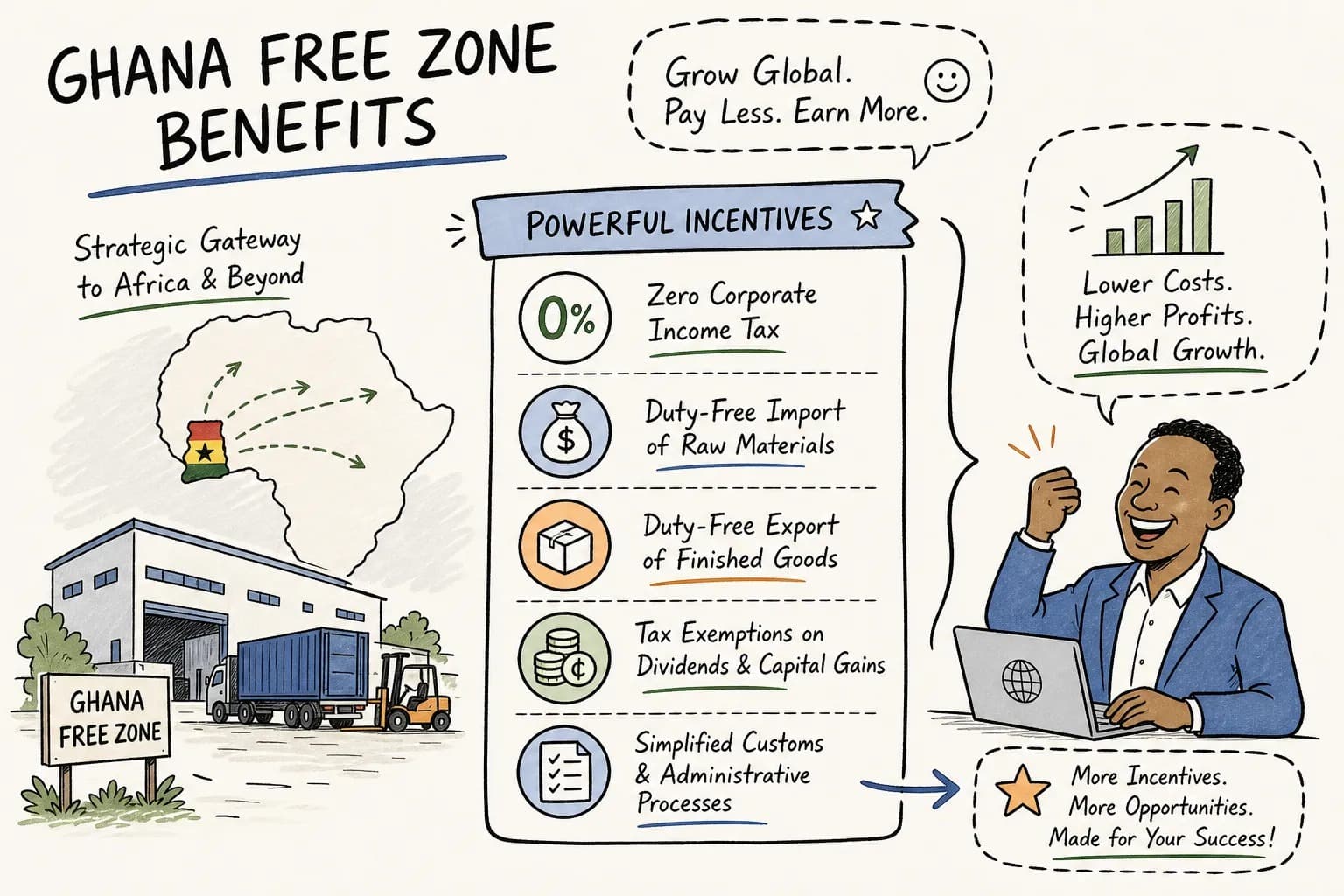
Ghana's free zone benefits are among the most structured, government-backed incentive frameworks available to export-oriented investors in West Africa. Enacted under the Free Zones Act, 1995 (Act 504) and administered by the Ghana Free Zones Authority (GFZA), the regime delivers measurable advantages: a 100% income tax holiday for the first ten years of operation, full customs-duty exemption on production inputs, and unrestricted repatriation of profits and capital. For any export-oriented manufacturer, ICT operator, or agro-processor looking to use Ghana as a base for regional and global trade, these free zone tax exemptions materially change the economics of the investment.
The challenge for most incoming investors is not the legislation itself but the execution gap: finding a compliant facility, navigating the GFZA application process, and structuring operations to stay on the right side of the export threshold. Purpose-built facilities like Goldbridge Industrial Park at Shai Hills, developed by The New Accra City Ltd (TNAC), are designed specifically to close that gap. By the time you finish reading this article, you will know exactly which incentives apply to your business, how to estimate your tax and duty savings, and what steps are required to get licensed.
Ghana free zone benefits: core tax incentives explained
A decade of zero income tax
Free Zone enterprises receive a 100% income tax holiday for the first ten years of operation. It is important to distinguish two separate exemptions here: the corporate income tax holiday, which eliminates income tax liability for ten years, and the parallel 100% exemption from customs duties, taxes, and levies on qualifying imports; both are provided under the Free Zones Act and GFZA
guidance, but they operate independently. The ten-year clock is generally understood to start from the date operations commence, not the date the licence is issued, a distinction that matters for financial modelling, as your tax-free window begins when you start producing and generating revenue. Investors are advised to confirm the precise commencement trigger with GFZA or a qualified Ghanaian tax adviser before finalising projections.
The exemption also extends to withholding tax on dividends from Free Zone investments, according to GFZA guidance, meaning dividend flows to parent companies and shareholders remain untaxed for the duration of the enterprise's operations. Investors should verify the specific conditions of this exemption, including any lifetime limitations, directly with the GFZA or Ghana Revenue Authority (GRA), as the statutory basis warrants independent confirmation. On a regional basis, the ten-year zero-tax structure compares favourably with incentive regimes in several neighbouring West African economies, though investors should conduct their own jurisdiction comparison before concluding.
Post-holiday tax rates and what they mean for your long-run projections
After the initial ten-year holiday, two tax frameworks come into play depending on which legislation you reference. The Free Zones Act caps post-holiday income tax at 8%, but more recent GRA guidance taxes export income at 15% and domestic-market sales at 25%. Investors modelling returns beyond a ten-year horizon should plan around the 15%/25% split, as the 15%/25% split reflects current tax law rather than the original Act. Readers are encouraged to cite both the Free Zones Act and current GRA guidance when reconciling these figures in their financial models.
In practical terms: revenue derived from exporting goods and services outside Ghana's customs territory is taxed at 15% post-holiday, while revenue from selling into the domestic market attracts 25%. Structuring your sales mix with these rates in mind from the outset produces accurate long-run projections and avoids surprises at year eleven.
Ghana free zone benefits: duty-free imports and customs exemptions
Full customs exemption on production inputs
Among the most tangible Ghana free zone benefits is the 100% exemption from customs duties, customs taxes, and levies on all imports brought into the zone for production purposes. This covers raw materials, machinery, equipment, spare parts, and packaging materials. No import licensing is required, which removes a layer of bureaucratic cost and delay that regularly affects non-Free Zone operators in Ghana.
For a manufacturer with significant imported inputs, the duty-free import savings compound quickly. A textile operation importing fabric, thread, and equipment avoids customs charges that would ordinarily represent a substantial recurring cost, potentially hundreds of thousands of dollars annually depending on input volumes and applicable tariff rates. Combined with the income tax holiday, the duty exemption substantially accelerates the payback period on the initial capital investment.
The boundary condition: when goods move into the customs territory
The duty exemption applies strictly to goods that remain within the Free Zone or are used in export production. Once finished goods cross into Ghana's domestic market, those goods are treated as imports and attract standard import duties and taxes. The GRA is clear that duties become payable once goods move from the Free Zone into home consumption; this is not a grey area.
Grasping this boundary clearly is essential before structuring your sales mix. If 30% of your output is destined for the Ghanaian market, factor in the import-duty cost on that portion from the beginning.
Treating it as an afterthought creates financial exposure that undermines the economics of Free Zone status itself.
Repatriation rights, ownership structure, and operational freedom
Unrestricted capital and profit repatriation
Free Zone enterprises can repatriate 100% of profits, dividends, fees, and capital without restriction. For multinationals consolidating earnings at the group level, this is a significant operational advantage over non-Free Zone structures, where repatriation can be subject to exchange-control conditions. A European or Asian parent company, for instance, avoids the approval processes and administrative delays that non-Free Zone operators typically navigate when moving capital across borders. The freedom to transfer funds without seeking approval reduces administrative friction and preserves treasury flexibility.
100% foreign ownership and double-tax relief
Free Zone companies can be 100% foreign-owned, 100% Ghanaian-owned, or structured as a joint venture. There is no mandatory local-equity requirement. For investors from countries that have double tax treaties with Ghana, additional tax relief may be available to both the enterprise and its foreign employees, reducing the effective tax burden further. Treaty coverage varies by jurisdiction, so investors should verify their home country's treaty position with Ghana before finalising their structure.
Eligible sectors: manufacturing, ICT, and services
The GFZA recognises a broad range of eligible activities across two broad groups. Physical manufacturing sectors include textiles and apparel, metal fabrication, pharmaceuticals, ceramics, agroprocessing, seafood processing, jewellery, and light assembly. On the ICT and services side, eligible activities include software development, data processing and transcription, hardware assembly, call centres, BPO operations, data centre development, and export-oriented commercial services.
The regime does exclude certain activities: plastic manufacturing, timber-related activities, and the extraction of precious metals, gas, and crude oil are not eligible. If your business falls outside these exclusions and operates an export-oriented model, the Free Zone framework is almost certainly relevant to you.
The 70% export rule: the qualification gate every investor must understand
How the export threshold works in practice
Free Zone enterprises must export at least 70% of their total output, or the specific percentage stated in their licence, to maintain exemption status. Up to 30% of production can be sold into Ghana's domestic market. That local revenue allowance is commercially meaningful: it lets export manufacturers serve the Ghanaian market and build a domestic customer base without forfeiting Free Zone status.
The 30% domestic allowance also provides a useful revenue buffer during periods when export demand softens. To illustrate: a manufacturer whose export orders decline in a given quarter can redirect up to 30% of output domestically without breaching the threshold, giving the business breathing room to stabilise. Investors should structure distribution agreements and sales forecasts with this ceiling in mind so the local portion never creeps above the permitted threshold without a deliberate licensing review.
The penalty for falling short and why compliance matters
Failing to meet the 70% export threshold carries serious financial and legal consequences. Research into the Exemptions Act, 2022 and related GRA guidance indicates that consequences can include recovery of
all tax benefits received, financial penalties, interest charges, and in serious cases, prosecution or licence revocation. Some sources reference a 300% recovery figure in specific penalty contexts, though the exact form and calculation basis of any monetary penalty should be confirmed directly against the Exemptions Act, 2022 or current GRA guidance before relying on it in financial modelling. For a business that has been operating tax-free for several years, a retroactive recovery of accumulated tax benefits is financially significant under any calculation method.
Internal tracking of output by destination is not optional. It is a compliance requirement and a financial safeguard. Investors should build destination-of-sale reporting into their ERP or accounting system from the first day of production and ensure audit readiness on this metric at all times. Free Zone status is valuable precisely because it is enforced: the GFZA monitors compliance, and the penalty structure ensures operators take the export threshold seriously.
Ghana Free Zone licence requirements: qualifying and applying
Who qualifies and what the authority looks for
To qualify for a Free Zone enterprise licence, the applicant must be a corporate entity incorporated in Ghana. The business must be export-oriented, demonstrate clear value addition to the goods or services being exported, and show the capacity to meet the 70% export requirement. There is no fixed minimum capital investment, but GFZA expects proof of funding. Where the business activity has environmental implications, an EPA permit is required before the licence is granted.
The step-by-step application process
The application process involves seven core steps:
1. Incorporate your company with the Registrar General's Department and obtain your certificate of incorporation and certificate to commence business.
2. Obtain and complete the official GFZA application form. The application fee has been cited variously as US$100 and US$200; verify the current fee with GFZA at the time of submission, as amounts are subject to revision.
3. Prepare the required supporting documents: a business plan or feasibility study, certificate of incorporation, company constitution, evidence of premises (lease, rental agreement, or letter of intent), an MOU or letter of intent from prospective clients, EPA permit where applicable, and evidence of funding or capital transfer.
4. Submit the complete application package to GFZA.
5. GFZA reviews the application and may request additional information or conduct a site inspection.
6. Receive a decision within 28 working days of submitting a complete application.
7. If licensed as a developer, commence development within six months of licence issuance.
The process is structured and predictable once your documents are in order. The 28-working-day decision window gives investors a clear planning timeline, and GFZA's eligibility criteria are publicly available, which removes ambiguity about whether a given business model qualifies.
Goldbridge Industrial Park: an investor-ready entry point into Ghana's Free Zone regime
A facility designed to deliver Free Zone benefits from day one
Setting up as a standalone, single-factory Free Zone enterprise requires the investor to establish their own compliance framework, negotiate land tenure, and demonstrate to GFZA that the infrastructure meets Free Zone standards. Goldbridge Industrial Park at Shai Hills, developed by The New Accra City Ltd (TNAC), is designed to remove that burden. The facility is being developed with Ghana Free Zones Act compliance, GFZA alignment, and a structured compliance framework as core design requirements. Incoming tenants are intended to arrive at a licensed facility and concentrate on production and sales rather than administrative groundwork, though investors should confirm GFZA approvals and the status of relevant licences directly with TNAC before committing.
For investors who have identified Ghana as a manufacturing or processing base but do not want to spend twelve to eighteen months building facility infrastructure before earning a single dollar of revenue, this represents a materially different entry point. The Ghana free zone benefits described in this article, the ten-year tax holiday, duty-free imports, unrestricted repatriation, and 100% ownership flexibility, are intended to be accessible to qualifying tenants from the commencement of operations, subject to each tenant obtaining the necessary GFZA licensing and meeting ongoing compliance requirements.
Location, connectivity, and what it means for export operations
Goldbridge's position within the Shai Hills corridor places tenants in proximity to the Port of Tema and the ECOWAS trunk road network. For export manufacturers, access to Tema shortens logistics chains, reduces transport costs, and connects operations to West African markets and international shipping routes. The eastern corridor location also positions Goldbridge-based operations within Ghana's AfCFTA trade architecture, where Ghana's port infrastructure and treaty relationships offer export manufacturers access to markets across the continent. Investors should request TNAC's technical brief and logistics data for specific distances, travel times, and connectivity details relevant to their supply chain planning.
TNAC operates as an execution-focused platform in a market where most announced infrastructure projects fail to reach financial close. Goldbridge is presented as a project with infrastructure in active development, government alignment, and institutional-grade planning. For investors entering Ghana's Free Zone regime, the execution stage of any facility partner matters as much as the incentive framework itself; due diligence on project status, financing, and approvals is strongly recommended.
Making the most of Ghana free zone benefits for your business
Ghana free zone benefits offer one of the most comprehensive, government-backed incentive stacks in West Africa. The ten-year income tax holiday, full duty exemption on production inputs, unrestricted profit
repatriation, and ownership flexibility combine to create a compelling economic case for export manufacturers, ICT operators, and agro-processors targeting African and global markets. The 70% export threshold is the single most important compliance condition: stay on the right side of it, and the benefits remain intact; fall short, and the financial and legal consequences are significant.
The application process is straightforward once your documentation is assembled. A registered Ghanaian entity, a credible business plan, evidence of premises and client intent, and an EPA permit where required are the building blocks. The GFZA has committed to a 28-working-day decision window, which makes planning timelines manageable.
For investors who want to accelerate the path from licence to production, Goldbridge Industrial Park at
Shai Hills is a logical starting point to explore. The Free Zone infrastructure is in active development, the Shai Hills corridor provides ECOWAS trade connectivity, and TNAC's execution framework is designed to help investors navigate the complexity that typically slows market entry. To find out more about investment opportunities at Goldbridge and how TNAC structures access to Ghana free zone benefits, reach out to The New Accra City Ltd directly.